




 OPC
OPC
what is OPC?
The term OPC often occurs along with the concept of SCADA (supervisory control and data acquisition). SCADA software usually needs to communicate with the electronic modules which use different communication protocols. These protocols allows different SCADA systems communicate with various devices using uniform OPC protocol. This allusive we can be likened to creating a software bus as shown in the following figure.
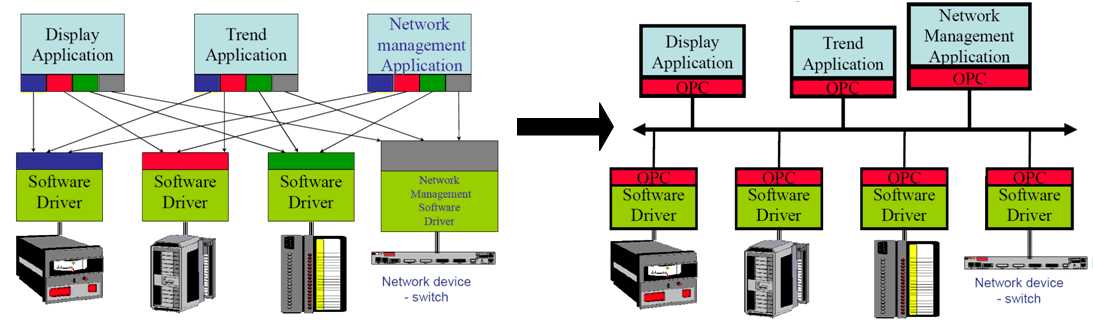
Figure: Creating a software bus using OPC technology
This is not the only use of OPC. Access to any data source, such as a xls-file, various databases, files in the "Windows - ini" format ... can be obtained by OPC as well.
In addition to the data transfer itself, it is necessary to ensure the same interpretation of messages on various semantic levels. Basic OPC standard is OPC DA (data access), which is used to transfer the process variables, such as measured and setpoint values or control deviation. To ensure data consistency, it is possible to pass all these variables in a single structured variable. Even if it only provides a simple process variable, in fact there are transferred three items: its value, quality - ie. information on whether this value can count and time stamp - time information when the data value have been gained.
Another of the OPC standard - the OPC AE (alarms and events) defines the interpretation of the data relating to alarms and events.
OPC uses a client / server architecture, ie., the communications protocol of the device is encapsulated in a server application. The data on the server can be used by multiple client applications. Practical implementation of the OPC standards enables concatenation of clients and servers. For example, OPC AE sever can be implemented as OPC DA client using the data from OPC DA server, and, at the same time, as the server providing data for OPC AE clients.
Mentioned standards along with other standards such as OPC HDA - access to historical data, OPC Batch - Batch processing, OPC Commands - execution of orders under the program, provide a methodology for application integration. OPC is associated with an important concept - OPC server address space, which is a data model of OPC applications. The importance of OPC applications based on their data model exceeds the importance of the single OPC communication protocol especially now. OPC technology was widely asserted in the past in connection with the use DCOM communication software technology from Microsoft and expand the use of its operating systems in industrial applications. Although the implementation of DCOM technologies exist for operating systems other companies, because of use communications software of a single company, use of OPC standards was perceived as limiting for interoperability. This problem partly solved the OPC XML-DA standard that defines communication using Web services. This has improved the interoperability, but decreased approximately 6x speed communication compared to DCOM. For this reason, the standard have been used mainly for transmission of aggregated data to ERP systems. But, already this standard has enabled the use of OPC technology in the SOA (service oriented architecture) systems. Another disadvantage was that all the OPC standard defines a separate address space. Efforts to eliminate these disadvantages led to the creation of the new OPC UA standard that includes all of the above mentioned standards, defining a single application data model - the common address space based on web services, and providing for faster data transfer (ingestion binary encoding) than that based on XML DA.
SAE - Automation, Ltd. is the 23rd-year devoted to the development of communication drivers including OPC technology. The OPC products allow the creation of complex applications for management, monitoring, control and visualization. OPC UA standard is already used in the latest version of its products SAEAUT SNMP OPC Server, SAEAUT UNIVERSAL OPC Server and OpcDbGateway. For a more detailed explanation of OPC technology, visit the OPC Foundation website.